


Demo forest Beegder- and Hornerheide
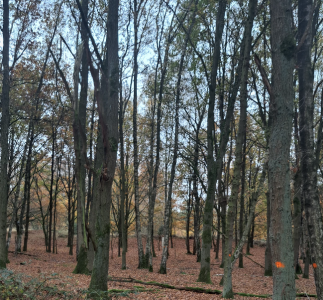
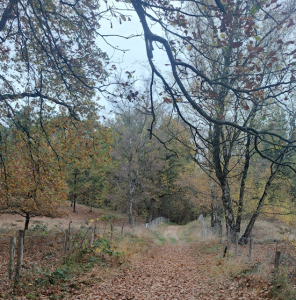
The Beegder- and Hornerheide is a forest area in Limburg with high recreational pressure, located in the municipalities of Maasgouw and Leudal, between the residential areas of Baexam, Heel, Beegden, Horn and Grathem. This forest and nature area lies at the transition from the Maas valley to the higher sandy soils on the western side of the Maas. The N273 and N280 motorways cross the area. It covers about 450 hectares and has a great landscape variety. The area varies from pine forests on drifting sand to dry and wet heathlands with scattered fens. On the northern side of the plan area are grasslands along the Haelense Beek.
The demo site within Beegder- and Hornerheide consists of 49 ha divided between three owners:
- Maasgouw municipality;
- Horn Castle;
- and Waterleidingmaatschappij Limburg (WML).
To increase the resilience of the forest area in the face of climate change, several targeted measures are being taken within the LIFE Climate Forest project. These are aimed at improving forest structure, increasing species diversity and preserving the local forest climate. After all, a structurally rich forest with a diverse mix of tree and shrub species is the basis for a stable, biodiverse and climate-resilient ecosystem.
Questions about this sample forest?
Do you have any questions about managing or visiting this demo site? If so, please contact Lisa Raats: l.raats@bosgroepen.nl.
Measures
During the project, the various forest owners will work together. These owners each have their own vision of the future of their forest and the measures that fit in. Three separate categories are used to flesh this out. Within all measures, the promotion of a mixed forest structure, variation in age classes and stratification are central. It also seeks to preserve and restore the forest climate, an essential factor.
The following issues were taken into account during forest tracking:
1. Climate-smart natural forest
Management of natural forests often aims to preserve and enhance biodiversity within the framework of a natural reference. Increasing resilience is usually not an explicit goal here. But natural forests are exposed to the same risks as multifunctional forests and also need that resilience to ensure their best possible functioning.
This category focuses on strengthening resilience of natural forests, using only native tree species. Contrary to ‘regular’ natural forest management, more intensive and active work is done to strengthen structure, mixing and increasing the proportion of vital trees. In principle, timber harvesting is always a function of increasing biodiversity and is therefore limited to measures whereby removal of wood simplifies implementation or benefits follow-up measures. The abandonment of felled wood and tree rings will therefore be used more often here.
2. European climate smart
This category is a multifunctional management type. In contrast to climate-smart natural forests, the focus here is on a sustainable production function and the full range of ecosystem services. This also includes biodiversity, of course. The species pool will be expanded with European native species. The concept of assisted migration is applied here: species that could theoretically reach the region on their own - in the long term - are literally helped to migrate faster by planting them. As this limits the species pool to Europe, there is a good chance that flora and fauna that can benefit from new tree species are already present, or may migrate here themselves later. Already established European tree species are also part of the species pool and are treated as native tree species.
Strengthening the forest structure and species mix by thinning is the basis of the strategy, whereby the forest composition will be steered more strongly to serve the broad function. Where good starting points for improving those parameters are lacking, replanting with native or European native species may be done. Future trees are not only selected for their contribution to biodiversity, but other characteristics that contribute to, for example, wood quality or forest experience also count. Timber harvesting is one of the objectives alongside diversity and experience.
3. Climate smart plus
This category aligns with European climate smart, but broadens the selection of tree species with suitable tree species from outside Europe. Thus, in this category, all native species are part of the species pool and Douglas-fir, American oak and American bird cherry are also treated as normal tree species. In addition, a broad pallet of new tree species is being experimented with, some of which also come from outside Europe. Again, the basis is thinning management in the forest composition and planting is only a point-by-point enrichment measure. Specifically, this management type makes a high contribution to knowledge development on the response of tree species to climate change.
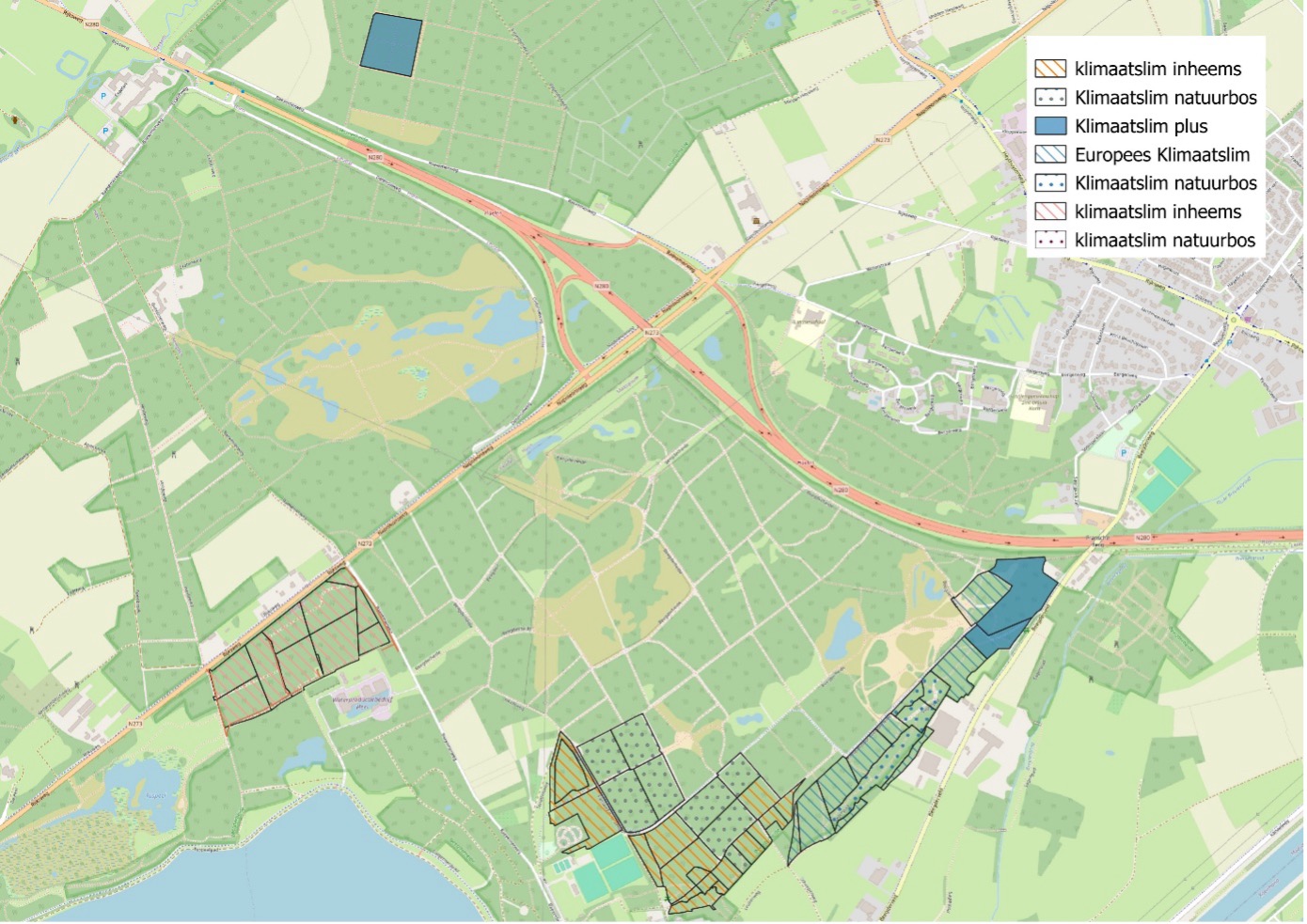
On the map above, the Castle Horn properties are marked as ‘Climate Smart Plus measure’ at the bottom right. Here, we will not plant species from outside Europe. The designation was chosen because American oak is dominant there, including in a number of large avenue trees, which we do not want to remove. In a European climate-smart scenario, however, this would be the case.